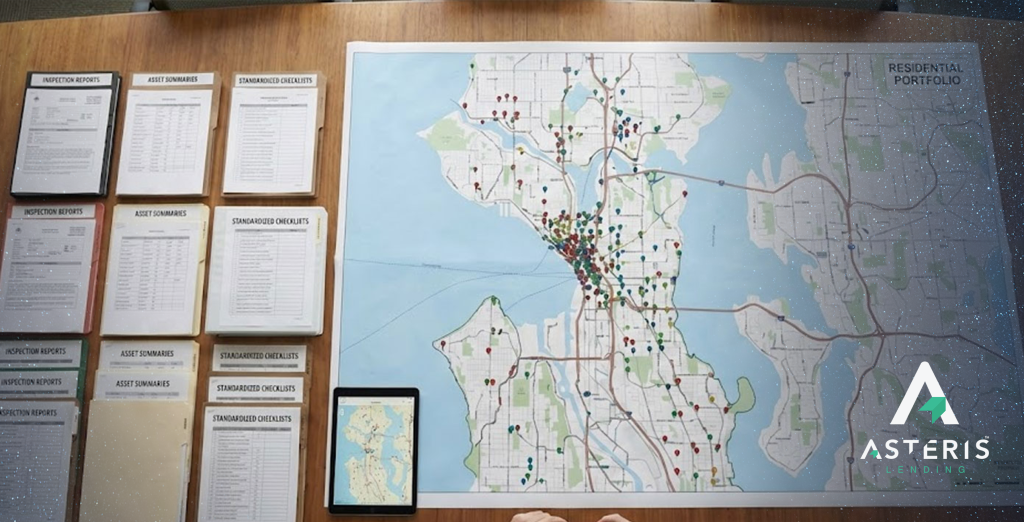
In a small real estate portfolio, risk is usually isolated. A single vacancy hurts one property’s cash flow. A surprise maintenance issue creates a localized cost. As your portfolio grows, however, those same issues become correlated. Vacancies can cluster, deferred maintenance can spread, and inconsistent data leads to mispriced decisions across the board. The purpose of building operational infrastructure, therefore, is not efficiency alone; it is error containment. It’s about creating systems that prevent small problems from becoming portfolio-level events. This is the primary function of a scalable due diligence process: a disciplined framework designed to manage complexity and contain risk as you grow.
Why portfolios don’t fail from lack of deals, but from lack of systems
The operational challenges of real estate rarely show up at the beginning. When a portfolio is small, diligence is informal, reporting is ad hoc, and oversight lives mostly in the operator’s head. That approach works, until it doesn’t.
Somewhere between a few dozen properties and true scale, the risk profile changes. What once felt manageable becomes fragile. Small errors compound. Missed details start to matter. Decisions that used to rely on instinct now require structure.
This is the stage where many portfolios stall, not because the assets are weak, but because the operating infrastructure has not kept pace with growth.
Scaling successfully past 100 doors requires a shift in mindset. Real estate stops being a collection of properties and starts becoming a system.
Understanding the Four Core Areas of Due Diligence
Due diligence isn’t just a single checklist; it’s a multi-faceted investigation. To build a resilient operating system for your portfolio, you need to examine every deal through four distinct lenses. Each area uncovers a different type of risk and gives you a more complete picture of the asset you’re considering. Think of it as a full physical for your potential investment. Skipping a step is like ignoring a doctor’s advice—you might feel fine for a while, but you could be missing a critical issue that will cause problems later. Getting this right is not only crucial for your own peace of mind but also for your financing partners, who need to see that you’ve thoroughly vetted the investment.
Financial Due Diligence
This is the first stop for most investors, and for good reason. Financial due diligence is all about making sure the numbers are real. You’re digging into the property’s financial history—profit and loss statements, rent rolls, and bank records—to verify the seller’s claims. The main goal is to confirm that the income and expenses presented are accurate, giving you a true understanding of the property’s cash flow. For real estate investors, this means scrutinizing every line item, from utility bills to maintenance costs. Having clean, verifiable financials is essential when you seek rental financing, as it demonstrates the asset’s stability and your credibility as an operator.
Operational Due Diligence
While financials tell you what has happened, operational due diligence tells you how it happened. This is where you assess the property’s day-to-day functions. How efficient is the current property management? Are there solid systems for maintenance requests, tenant screening, and rent collection? This investigation helps you identify the strengths and weaknesses in how the business runs. For a fix-and-flip project, for example, understanding the operational workflow is key to hitting your timeline and budget. A strong operational foundation prevents small mistakes from spiraling and is a critical component for securing flexible funding like bridge loans designed for transitional assets.
Legal Due Diligence
Legal due diligence is your shield against hidden liabilities. This process, usually handled by attorneys, involves a deep dive into contracts, titles, permits, and zoning regulations to ensure full compliance. The objective is to uncover any legal skeletons in the closet, like pending lawsuits, title defects, or code violations that could jeopardize your investment. Forgetting this step can lead to costly surprises down the road. This is especially true for ground-up development, where securing the right permits and adhering to zoning laws is fundamental. A clean legal bill of health is non-negotiable when you’re ready to finance a new construction project.
Human Resources (HR) Due Diligence
You might not think of HR when buying a duplex, but as you scale, it becomes incredibly important. HR due diligence focuses on the people behind the property. If you’re acquiring a larger asset with on-site staff or taking over a property management company, you need to assess the team. This means reviewing employment contracts, checking for compliance with labor laws, and understanding the management structure. The goal is to make sure you’re not inheriting any significant workforce-related risks. This “people diligence” is vital for investors growing into institutional-grade portfolios, where a strong team is just as valuable as the properties themselves.
Why scale changes the nature of risk
At smaller sizes, most operational risks are isolated. A vacancy hurts one property. A maintenance issue creates a localized cost. A missed report is inconvenient, but not catastrophic.
As portfolios grow, those same issues become correlated. Vacancies cluster. Deferred maintenance spreads. Inconsistent data leads to mispriced decisions. The margin for error narrows because the number of moving parts increases.
The purpose of operational infrastructure is not efficiency alone. It is error containment. Systems prevent small problems from becoming portfolio-level events.
Due diligence at scale is about pattern recognition
Early-stage investors tend to evaluate assets one at a time. They focus on property condition, rent comparables, and immediate repair needs. At scale, diligence must evolve.
What matters most is not whether a single roof needs replacement, but whether roofs across the portfolio share similar age profiles. Not whether one market is softening, but whether exposure is concentrated in a way that amplifies downside.
Effective scaled diligence shifts from asset review to pattern detection. That requires standardized inputs, consistent inspection criteria, and the ability to compare assets against one another quickly.
Without that structure, operators end up reacting to issues instead of anticipating them.
The Importance of a Solid Data Structure
That critical shift to pattern detection is impossible without a system for your data. How you store the information you collect is the bedrock for everything that follows, from generating reports to analyzing performance across your portfolio. If your property managers send updates in different formats or inspection notes are a jumble of texts and emails, you don’t have data—you have a collection of anecdotes. When managers can send answers in any format they want, your team wastes countless hours cleaning up information before it can even be used. A solid data structure means standardizing your inputs with specific fields and rules. Instead of a free-form field for “roof condition,” you use consistent criteria. This isn’t just about being tidy; it’s about creating a single source of truth that makes meaningful comparison and analysis possible.
Enabling AI and Advanced Analytics
This structured approach is what prepares your portfolio for the future. Powerful AI and advanced analytics tools are only as good as the data they’re fed; if the data is messy or inconsistent, the AI’s results will also be messy and unreliable. With clean, structured data, you can start asking bigger questions. You can use analytics to predict which properties are most likely to need capital expenditures, identify markets where rent growth is outpacing projections, or model the financial impact of different renovation strategies. This level of insight transforms you from a reactive owner into a proactive asset manager, making your portfolio more resilient. It also makes you more attractive to partners who value sophisticated operations, positioning you to work with capital advisors and scale your financing effectively.
Asset management systems replace individual oversight
At 100 doors, it becomes impossible for one person to know every detail. The role of asset management changes from hands-on control to performance monitoring.
Strong asset management systems answer a few essential questions continuously. Which assets are underperforming relative to expectations? Where are expenses drifting? Which properties require intervention now rather than later?
These systems rely on regular reporting cycles, clear performance benchmarks, and defined escalation thresholds. The goal is not micromanagement. It is early detection.
When asset management is disciplined, decisions become deliberate instead of reactive.
Evaluating Technology and Software (Software Due Diligence)
As your portfolio grows, so does your reliance on technology. The spreadsheets and basic property management software that worked for ten doors can become a significant liability at one hundred. This is why software due diligence is so important. It’s a thorough assessment of your company’s technology to find problems before they find you. It’s about asking critical questions: Can our current systems handle a sudden increase in properties? Do our different software tools communicate with each other, or are we stuck with manual data entry? Answering these questions ensures your technology is a growth asset, not an operational bottleneck that could slow your expansion or complicate your ability to secure institutional portfolio lending.
Uncovering Technical Debt
One of the most important things software due diligence uncovers is “technical debt.” This isn’t just for tech companies; it’s a very real concept for real estate operators. It’s the result of choosing easy, short-term solutions over more sustainable, long-term ones. In real estate, this looks like a patchwork of disconnected spreadsheets, outdated property management software, or manual workarounds that are prone to human error. Think of it as the operational equivalent of deferring critical maintenance on a property. While it might save time or money upfront, it creates messy internal processes that slow you down, increase costs, and introduce security risks. Ignoring it can lead to expensive surprises and delayed decisions, holding your portfolio back when it’s ready to scale.
Reporting is a decision-making tool, not a compliance exercise
Many operators treat reporting as something done for lenders or partners. At scale, that approach becomes a liability.
Good reporting exists to support internal decisions. It allows operators to allocate capital intelligently, prioritize attention, and measure whether strategy is working.
The most effective reporting systems are consistent, timely, and intentionally boring. They surface trends rather than anecdotes. They highlight deviation rather than noise.
When reporting is fragmented or delayed, decisions are made on incomplete information. At scale, that compounds risk faster than almost any external factor.
Inspections evolve from events to processes
In smaller portfolios, inspections happen when something feels wrong. At scale, waiting for intuition is too slow.
Inspection systems need to be scheduled, standardized, and documented. This applies to physical condition, safety compliance, and operational quality.
The purpose of routine inspections is not control. It is predictability. When inspections follow a consistent cadence, maintenance planning improves, capital expenditures become smoother, and surprises diminish.
The best operators treat inspections as inputs into planning, not responses to failure.
Capital reserve policies protect optionality
One of the most common scaling mistakes is over-optimizing for leverage. As portfolios grow, liquidity becomes more valuable than marginal return.
Capital reserve policies formalize discipline. They define how much liquidity is maintained, when reserves can be used, and how replenishment occurs.
These policies prevent emotional decision-making during periods of stress. They also increase credibility with lenders and partners, who understand that resilience is built intentionally, not improvised.
At scale, optionality is often more valuable than efficiency.
Organizational clarity matters as much as systems
Infrastructure is not only technological. It is organizational.
Clear roles, documented processes, and defined decision rights reduce friction as teams grow. Ambiguity creates delays. Delays create cost.
Operators who invest early in organizational clarity spend less time untangling decisions later. That clarity allows leadership to focus on strategy rather than operations.
Alternative Scaling Strategy: Outsourcing Due Diligence
Building robust, in-house systems takes time and capital—two resources that are often better spent on acquiring assets. For investors in a growth phase, outsourcing due diligence offers a practical path to scaling without the operational drag. This isn’t about cutting corners; it’s about leveraging specialized expertise. By partnering with a firm that lives and breathes due diligence, you can instantly access institutional-grade processes and handle a higher volume of complex transactions with confidence. It allows you to focus on your core strength—finding great deals—while a trusted partner manages the verification and analysis.
A key benefit of outsourcing is the immediate discipline it imposes on your data. Third-party diligence providers operate on standardized inputs and consistent reporting, which is the foundation for effective risk management at scale. This structured approach shifts your analysis from reviewing individual properties to detecting patterns across your portfolio. More importantly, these external systems are designed for error containment, preventing small oversights from becoming portfolio-level problems. This level of rigor not only protects your investment but also strengthens your credibility with capital partners, who recognize the value of a systematic and professional approach to asset management.
The Asteris perspective
We work with operators across growth stages, and the pattern is consistent. Portfolios that scale smoothly invest in infrastructure before it becomes urgent. Portfolios that struggle wait until systems fail.
Operational discipline is not overhead. It is a growth enabler.
As portfolios move beyond 100 doors, capital decisions become inseparable from operational capability. Financing structures, reserve policies, reporting quality, and asset management all interact.
If you are preparing for the next phase of growth, the most important question is not how many properties you can acquire, but whether your systems can support them.
To learn more about how we work with operators building at scale, visit AsterisLending.com.
Frequently Asked Questions
I’m great at finding deals. Isn’t that the most important skill for scaling my portfolio? Finding good deals is essential, but it’s only half the battle. As your portfolio grows, the biggest risk isn’t a lack of opportunities; it’s a lack of systems to manage them. The informal, instinct-driven approach that works for a handful of properties becomes a liability at scale. Without solid operational infrastructure, small issues like a single vacancy or a maintenance delay can create a domino effect, impacting your entire portfolio.
At what point should I start building these kinds of operational systems? There isn’t a magic number, but the need often becomes clear when you can no longer personally oversee every detail of every property. This transition typically happens somewhere between a few dozen and one hundred properties. If you find yourself constantly reacting to problems instead of anticipating them, or if your reporting feels chaotic and inconsistent, it’s a strong signal that your operations haven’t kept pace with your growth. The key is to start building these systems before the cracks begin to show.
What does “technical debt” actually look like for a real estate investor? Technical debt is the collection of shortcuts you take that create problems later. In real estate, it might be relying on a patchwork of disconnected spreadsheets to track financials, using different reporting formats for each property, or sticking with outdated software because it seems easier than upgrading. While these solutions might work in the short term, they create messy, inefficient processes that are prone to error, slow down decision-making, and ultimately limit how effectively you can grow.
The article mentions four types of due diligence. Do I really need to worry about HR when I’m just buying property? For smaller acquisitions, probably not. However, as you scale into larger assets or portfolios, HR due diligence becomes critical. If you’re acquiring a property that comes with an on-site management team or buying a local property management company as part of your expansion, you are also acquiring a workforce. You need to investigate employment contracts, compliance with labor laws, and the overall team structure to ensure you aren’t inheriting hidden liabilities or personnel issues.
Building all this infrastructure sounds like a full-time job. Is there a more practical way to scale? Yes, and it’s a strategy many successful operators use: outsourcing. Instead of spending your own time and capital building an entire due diligence department from scratch, you can partner with a specialized firm. This gives you immediate access to institutional-grade systems, standardized reporting, and expert analysis. It allows you to focus on what you do best, which is finding and closing deals, while ensuring your risk management process is professional and scalable from day one.
Key Takeaways
- Focus on systems, not just assets: To scale beyond a few properties, your focus must shift. Build standardized systems for data, reporting, and inspections to contain risks and prevent small errors from affecting your entire portfolio.
- Go beyond financial diligence: A complete risk assessment involves more than just the numbers. Create a repeatable process to investigate the operational, legal, and human resources aspects of every deal to protect your investment and strengthen your position with lenders.
- Standardize your data for better insights: Messy data leads to reactive decisions. By creating a consistent structure for all your information, you enable pattern recognition and advanced analytics, which helps you anticipate issues instead of just responding to them.
Related Articles
- Scaling Due Diligence and Operations: How to Build Infrastructure for 100+ Doors
- 5 Benefits of Institutional Portfolio Lending
- Why Rental Financing Should Evolve as Your Portfolio Grows
